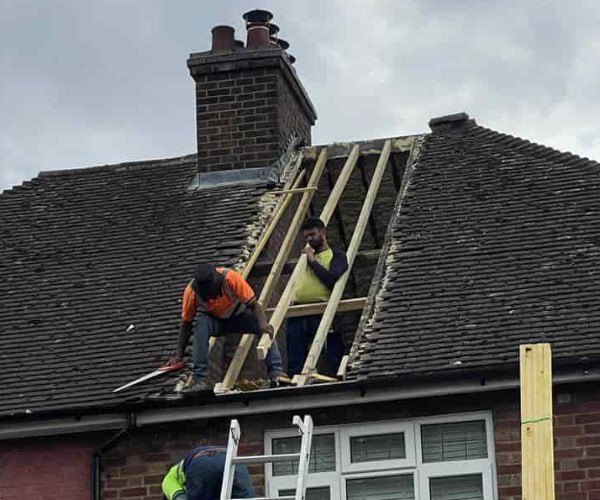
Why Professional Diagnosis Matters Before Any Roof Leak Repair
A damp patch or dripping ceiling confirms that water has entered a property, but it does not necessarily reveal where the roof has failed. Rainwater can travel along underlay, roof timbers, insulation or pipework before appearing inside, meaning the visible symptom may be some distance from the original defect.
Professional diagnosis establishes how water is entering, how far it has travelled and which roofing components have been affected. This information is essential if the repair is to address the cause rather than temporarily cover the symptoms.
How Accurate Roof Leak Diagnosis Leads to Better Repairs
The Internal Stain May Not Be Below the Leak
Water often follows the easiest available route after passing through the roof covering. It may run down a rafter, collect on the underlay or move across a ceiling joist before dripping into the room below.
As a result, repairing the roof directly above an internal stain can be ineffective. The actual entry point may be higher up the roof or beside a chimney, valley or other junction.
An experienced roofer traces the moisture path rather than relying solely on where the water becomes visible.
Similar Symptoms Can Have Different Causes
Several roofing defects can produce almost identical signs inside a property. A ceiling stain could result from:
- A cracked or slipped tile
- Damaged lead flashing
- A failed roof junction
- Deteriorated underlay
- A blocked valley or outlet
- A localised flat roof defect
- Water overflowing from ineffective drainage
- A failed seal around a vent or pipe
The correct repair depends on the source. Replacing a tile will not resolve water ingress caused by faulty flashing, just as sealing a visible joint will not correct damaged material beneath it.
Weather Patterns Provide Important Clues
Understanding when the leak occurs can help narrow down its cause. A leak that appears during wind-driven rain may suggest water is entering beneath a displaced tile or through a vulnerable junction.
A problem that develops only after prolonged rainfall could be linked to saturated materials, slow drainage or water collecting in a valley. Leaks that appear quickly during every downpour may indicate a more direct opening in the covering.
Professional diagnosis considers these patterns alongside physical evidence from the roof and interior.
The Roof Space Can Reveal the Water’s Route
Where access is available, inspecting the loft or roof space can provide valuable information. Water staining, damp insulation and discoloured timber may show how moisture has moved through the structure.
A roofer may check for:
- Damp or stained rafters
- Wet insulation
- Marks on the underlay
- Moisture around fixings
- Daylight through gaps
- Damage near chimneys or roof penetrations
- Signs of repeated water entry
The highest visible moisture mark can help direct the external inspection, although it should not be treated as proof of the entry point without further checks.
The External Inspection Must Cover More Than Tiles
Tiles and slates are only part of the roofing system. Flashing, ridges, verges, valleys, gutters and penetrations all help manage water.
A professional inspection should consider how these components meet and whether they remain secure. A small gap at an abutment or chimney can admit water even when the surrounding roof covering appears undamaged.
The condition of nearby materials also matters. One displaced tile may be linked to a deteriorated fixing or batten rather than being an isolated problem.
More Than One Defect May Be Present
Some roofs contain several weaknesses at the same time. One may be responsible for the visible leak, while another has not yet produced an internal sign.
Focusing on the first obvious defect can therefore leave related problems unresolved. A broader inspection helps determine whether the leak is truly localised or part of wider deterioration.
This does not mean unnecessary work should be carried out. It allows the repair to be planned using a complete understanding of the affected section.
Accurate Diagnosis Prevents Repeated Patching
A patch may stop visible water temporarily without correcting the route through which it enters. Moisture can return around the edge of the repair or emerge elsewhere after being redirected.
Recurring leaks often occur because:
- The wrong area was repaired
- Only the visible symptom was treated
- Damage beneath the covering was overlooked
- An adjacent junction remained defective
- Drainage problems were not addressed
- Multiple entry points were present
Finding the underlying cause before work begins reduces the likelihood of repeated repairs to the same part of the roof.
It Helps Keep the Repair Appropriately Localised
Correct diagnosis does not always lead to extensive work. In many cases, it confirms that a targeted repair is suitable because the surrounding materials remain serviceable.
Depending on the findings, the work may involve securing or replacing roof coverings, renewing flashing, repairing a membrane, restoring a junction or clearing a drainage route.
The value of the inspection is that it identifies the level of work genuinely required rather than relying on assumptions.
Supporting Materials Must Also Be Checked
Water may affect components concealed beneath the roof covering. Battens can become damp, underlay may tear or deteriorate, and insulation can retain moisture.
If these materials are ignored, repairing the outer surface alone may leave hidden damage in place. A professional assessment considers whether the supporting layers remain capable of performing correctly.
This helps restore the roof as a complete weather-resistant system rather than treating only its visible exterior.
Why Early Investigation Matters
The longer a leak continues, the further moisture may spread. This can make the original route more difficult to trace and increase the number of affected materials.
Arranging an inspection when staining, dripping or dampness first appears gives the roofer clearer evidence to work with. Early diagnosis may also allow the necessary repair to remain confined to a smaller area.
Conclusion
Professional diagnosis is the foundation of an effective roof leak repair. It identifies the true entry point, distinguishes between possible causes and reveals whether surrounding or concealed materials have also been affected.
WS Roofing South Elmsall provides professional roof leak detection and repairs in South Elmsall, West Yorkshire. If you have noticed water ingress or recurring dampness, contact our team to arrange an inspection and determine the appropriate repair.
Call us on: 01977 804 687
Click here to find out more about WS Roofing South Elmsall
Click here to complete our contact form and see how we can help with your roofing needs.